

What Does It Tell You About The Chemical Makeup Of Glucose And Starch
More than Circuitous Biological Molecules
Carbohydrates
Sugar Molecules
The stuff of life is amazingly diverse and complex, but it is all based on combinations of simple biological molecules. Biological molecules are often fabricated from chains & rings of carbon. These molecular structures can be represented by "stick drawings" that show the component atoms (eastward.g., C, H, N, O for carbon, hydrogen, nitrogen, and oxygen respectively) and show the bonds between them as dashes. A unmarried nuance ( - ) represents a single bond, and a double nuance (=) represents a double bail.
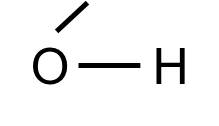
Note that some common "groups" are depicted without showing the bonds between them. For example, the hydroxyl group (-OH) consists of a hydrogen atom bonded to an oxygen atom:
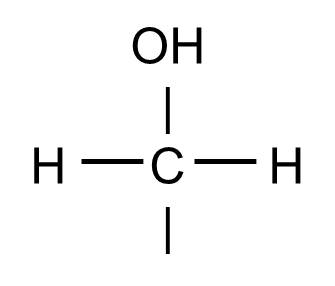
The hydoxyl grouping will unremarkably be bonded to a carbon atom in this fashion:
And this structure might be institute, for example, equally part of a glucose molecule, depicted below.
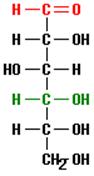
This molecule of the saccharide glucose consists of 6 carbon atoms bonded together as a concatenation with additional atoms of oxygen and hydrogen. Annotation that the previous structure (a carbon to which two hydrogens and i hydroxyl group are bound) is located at the lesser of this glucose chain where information technology is written using the notation CH2OH.
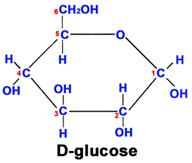
This glucose chain forms a band in aqueous solutions, e.g., in trunk fluids, equally shown below.
Fructose is some other sugar that likewise has 6 carbons, 12 hydrogens, and vi oxygen atoms. Nevertheless, the arrangement of the atoms is different, and this makes it much sweeter than glucose and also affects its ability to combine with other molecules.
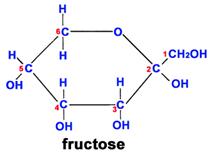
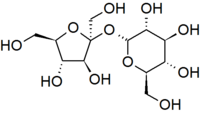
Another important theme is that single units of biological molecules (monomers) tin can join to class increasingly complex molecules (polymers). For example, two monosaccharide sugars tin also get bound together chemically to form a disaccharide. Sucrose is the disaccharide in common sugar that we buy at the grocery shop. The structure of sucrose is shown below.
Polysaccharides: Starch, Glycogen, and Cellulose
Glucose and fructose are examples of monosaccharides, significant they consist of a single carbohydrate unit, while sucrose is an example of a disaccharide. However, sugar units tin be bonded or linked together to form polysaccharides, which consist of many sugars linked together to form extensive chains of sugars. Plants shop energy as starch, which consists of very long chains of glucose linked together.
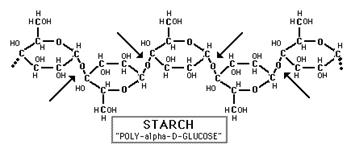
Source: http://www.science-projects.com/Amylase.htm
Animals store energy every bit glycogen, which consists of more than highly branched chains of glucose. Collectively, sugars, starch, and glycogen are know equally carbohydrates, and they are an important source of cellular free energy.
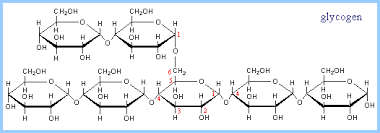
Source: https://world wide web.rpi.edu/dept/bcbp/molbiochem/MBWeb/mb1/part2/glycogen.htm
Cellulose is yet another polysaccharide formed from glucose. Cellulose is composed of unbranched, parallel chains of glucose. A key feature is that the chains bond to ane another to form stiff fibers that serve a structural purpose. Humans exercise non have the enzymes necessary to break the bonds in cellulose, and whatsoever cellulose nosotros ingest passes through our digestive systems. It is a major component of what we refer to as dietary "fiber."
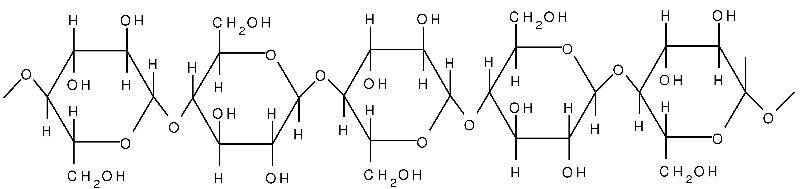
Source: http://www.intechopen.com/books/cellulose-primal-aspects/cellulose-microfibril-bending-in-forest-and-its-dynamic-mechanical-significance
Source: https://sphweb.bumc.bu.edu/otlt/mph-modules/ph/ph709_basiccellbiology/PH709_BasicCellBIology3.html
Posted by: whitleytogglike.blogspot.com
0 Response to "What Does It Tell You About The Chemical Makeup Of Glucose And Starch"
Post a Comment